Crypto OTC desk banking for MSBs: how to settle the euro leg
By Artem Balduk, Account Executive at PaySaxas
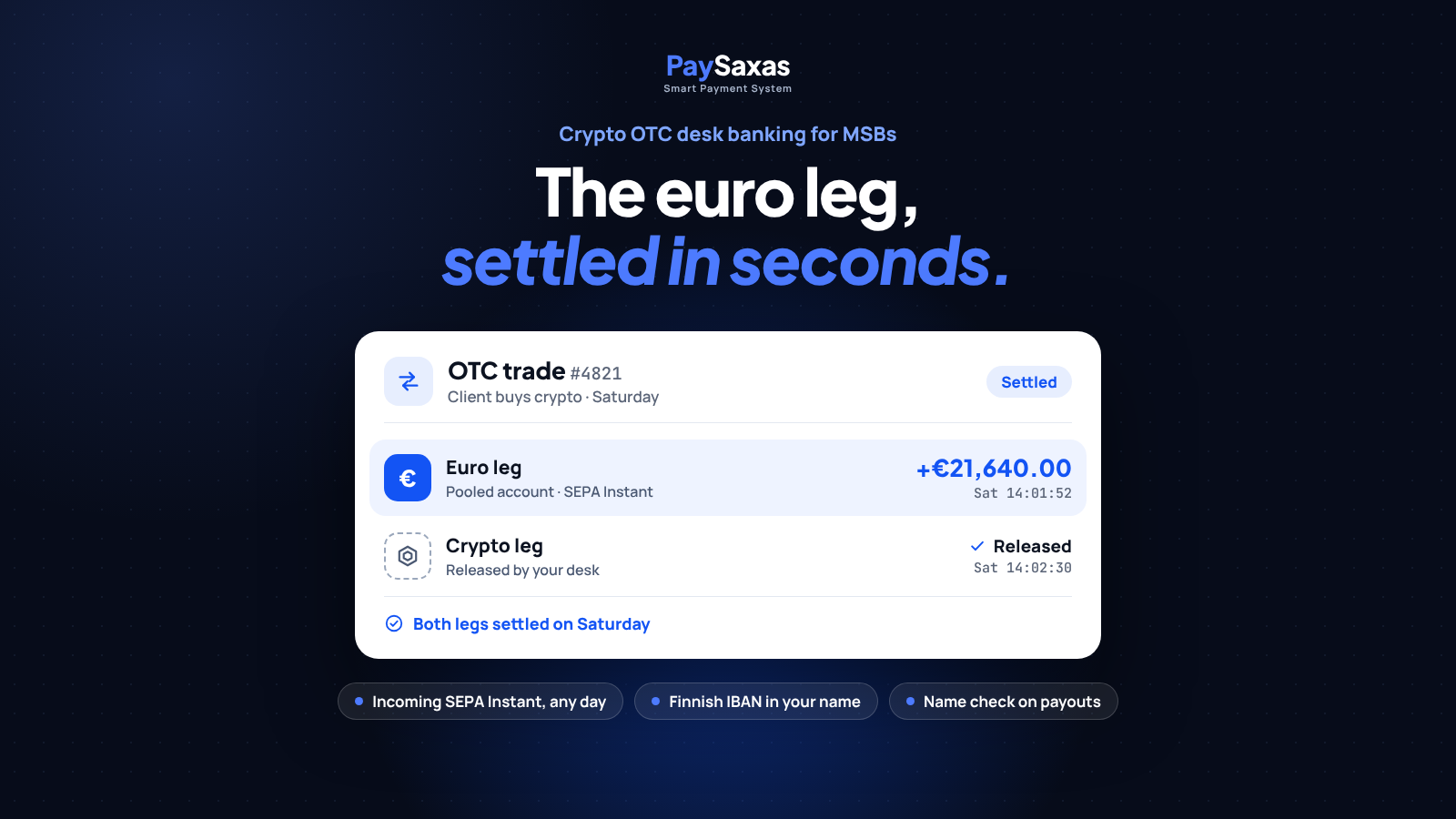
If your MSB runs a crypto OTC desk, the crypto leg of a trade settles in minutes. The euro leg is where trades get stuck: slow wires, payments to an account in the wrong name, client money mixed with your own. The right OTC desk bank account fixes most of that.
Compliance pressure on crypto MSBs is also rising. In October 2025, FINTRAC imposed the largest penalty in its history, C$176.9 million, on a money services business dealing in virtual currency. For violations after 26 March 2026, amendments to Canada's anti-money laundering law allow penalties of up to 40 times the previous maximums. A clean, well-documented euro leg makes every conversation with your provider, your auditor and the regulator easier.
This guide explains what the euro side of an OTC desk needs, where it usually breaks and how to set it up with one provider.
What an OTC desk bank account needs to do
Crypto markets never close, and your clients expect their money just as fast. A good OTC desk bank account can:
- receive client payments in seconds, any day of the week, so a trade closed on Saturday does not wait until Monday;
- sit in your company's name, so your clients' banks see a matching name when they pay you;
- keep client flows apart from your own money, so you can always show whose money is whose;
- handle many payments in and out with references you can match to trades;
- come from a provider that works with MSBs and agrees your expected volumes before you go live.
Where the euro leg breaks
Slow rails. A euro wire from a Canadian account often passes through correspondent banks and cut-off times. By the time it lands, the crypto has long been delivered, and your desk carries the risk in between.
The wrong name on the account. If your euro account is a provider's collective account, your clients' banks may show a "No match" warning when they pay you. Some clients stop right there. Since Verification of Payee became mandatory in the euro area, this is a daily issue.
Everything in one account. Your margin, client deposits and operating costs share one IBAN. As a result, reconciliation turns into a spreadsheet exercise, and the set-up is hard to explain to an auditor.
Third-party payments. A client pays from a relative's account or from another company. Payments like these often get returned, held or questioned.
Surprise holds on large tickets. A trade far above your usual size can trigger a manual review at your provider, just when the counterparty is waiting.
No provider at all. Many providers do not serve crypto-related businesses, so an OTC desk bank account is hard to find, and desks end up with one fragile account or none.
Euro settlement with PaySaxas: three accounts, one provider
With PaySaxas Oy, an electronic money institution licensed and supervised in Finland, your MSB holds its euro accounts in its own name. Each account has its own Finnish IBAN and direct access to SEPA and SEPA Instant.
PaySaxas Oy does not hold, exchange or transfer crypto-assets. The crypto leg stays with your desk, and we cover the euro side.
Pooled account: your OTC settlements
This is the working account of your desk. Client deposits for trades, payouts after trades and settlements with OTC counterparties all run through it. You keep the ledger of whose money is whose, and the account keeps those flows away from your operating money.
Funds on the pooled account are meant to move on. Balances that stay belong on a safeguarding account.
Operational account: your own money
Your margin, salaries, suppliers and taxes. PaySaxas fees are charged to this account, never to the accounts that carry client funds.
Safeguarding account, as an option
If clients keep euro balances with you between trades, a dedicated safeguarding account keeps them apart from your own funds, with a reference letter from PaySaxas Oy. If you are a payment service provider in Canada, read how RPAA safeguarding works for MSBs.
How a trade settles in practice
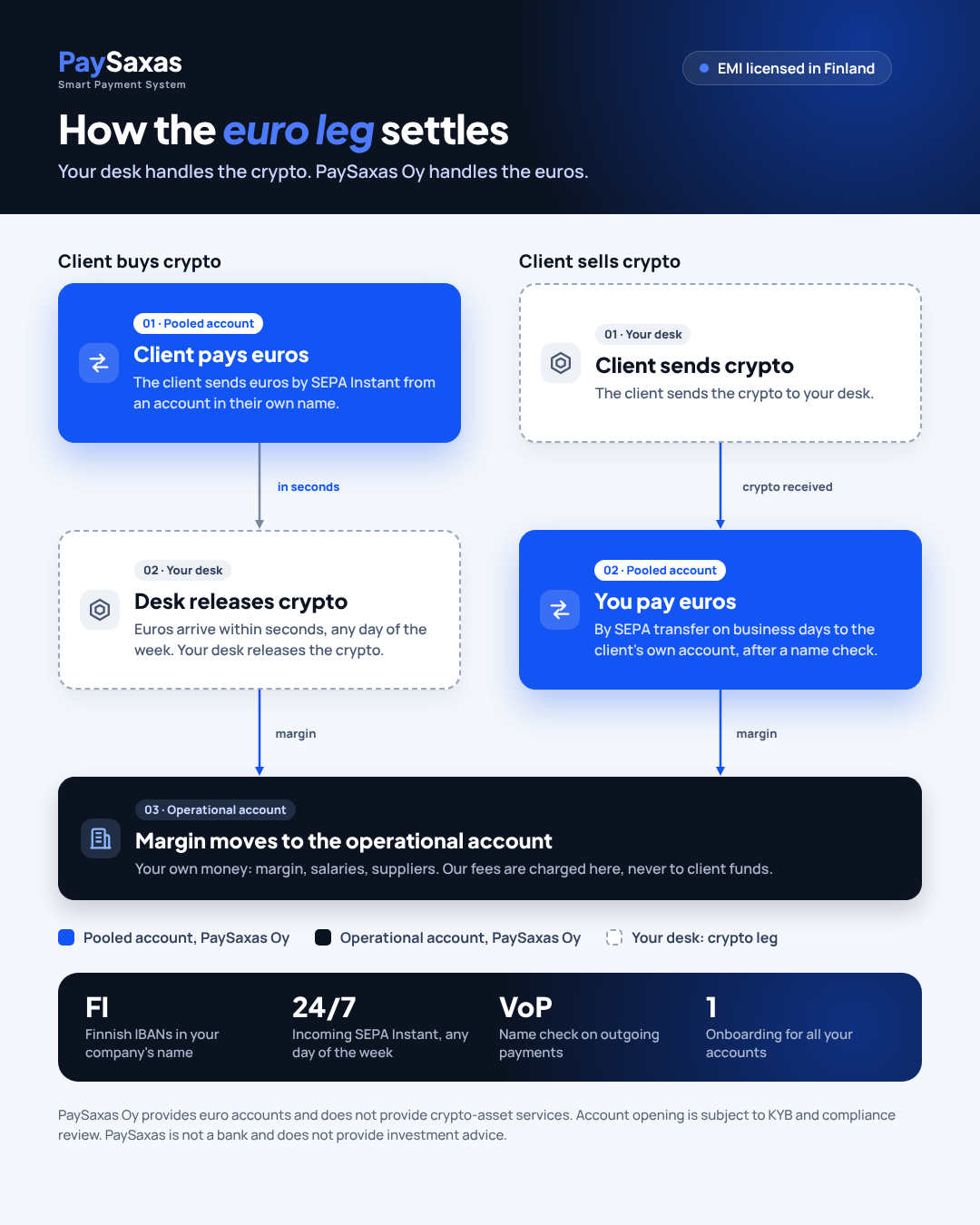
Your client buys crypto:
- The client sends euros by SEPA Instant from an account in their own name to your pooled account.
- The funds arrive within seconds, on any day, and your desk releases the crypto.
- Your margin moves to the operational account.
Your client sells crypto:
- The client sends the crypto to your desk.
- You pay euros from the pooled account to the client's own account by SEPA transfer on a business day. Verification of Payee checks the name before the payment leaves, and the funds arrive by the next business day.
- Your margin moves to the operational account.
Incoming payments arrive in seconds when the client's bank sends them by SEPA Instant. Banks in the euro area have had to offer instant euro payments since October 2025.
Five habits that keep the euro leg clean
Whichever OTC desk bank account you use, these habits save time and questions:
- Take euros only from accounts in your client's name. It is the simplest control there is, and it avoids many returns and questions.
- Put the trade ID in every payment reference. Reconciliation and any later review become much faster.
- Ask clients to pay by SEPA Instant. The shorter the gap between the two legs, the less risk your desk carries.
- Tell your provider about unusually large trades in advance. A short note before a large settlement is better than a hold in the middle of it.
- Keep trade records ready. Quotes, confirmations, wallet addresses, travel rule data for transfers of C$1,000 or more, and source of funds for large clients.
What to prepare for onboarding
Opening an OTC desk bank account takes some preparation. As crypto businesses, OTC desks usually go through enhanced due diligence with any regulated provider. Expect questions about:
- your FINTRAC registration as an MSB and any other licences;
- your AML programme, including how you apply the travel rule and report large virtual currency transactions of C$10,000 or more;
- how you screen wallets, clients and counterparties;
- expected monthly volumes, typical ticket sizes, countries and main counterparties;
- your ownership and management.
Clear answers at the start usually mean fewer questions later. Every regulated client is assessed case by case.
Serving clients in the EU
PaySaxas Oy provides your euro accounts, not a crypto licence. If your desk serves clients in the EU, check with your counsel whether MiCA applies to you. The transitional period for crypto service providers in the EU ended on 1 July 2026 at the latest. Our guide to the MiCA deadline explains what changed.
Why MSBs choose PaySaxas
- Licensed in Finland. PaySaxas Oy is an electronic money institution supervised by FIN-FSA.
- Real IBANs in your name. One Finnish IBAN per account, no virtual IBANs.
- Direct SEPA and SEPA Instant, with Verification of Payee on outgoing payments.
- One provider, one onboarding for operational, pooled and, as an option, safeguarding accounts.
Final thoughts
Your desk already moves crypto in minutes. A good OTC desk bank account lets the euro leg keep up: an account in your own name, client payments that arrive in seconds on any day and client flows kept apart from your own money.
Talk to our team about operational and pooled accounts for your OTC desk, or read more about MSB business accounts.
Account opening is subject to KYB and compliance review. PaySaxas Oy does not provide crypto-asset services. PaySaxas is not a bank and does not provide investment advice. This article is general information, not legal advice.
FAQ
What is an OTC desk bank account?
It is the account an OTC desk uses for the fiat leg of its trades: receiving money from clients, paying them out and settling with counterparties. For euro trades, it works best in your company's name and with SEPA Instant.
Can a Canadian MSB open a euro account with PaySaxas?
Yes, subject to KYB and a risk assessment. PaySaxas Oy works with regulated clients, including Canadian MSBs, and assesses each one case by case.
Does PaySaxas handle the crypto side of my trades?
No. PaySaxas Oy provides euro accounts and SEPA payments. The crypto leg stays with your desk.
How fast does the euro leg settle?
Incoming SEPA Instant payments arrive within seconds, any day of the year, when the client's bank sends them that way. Payouts to your clients usually go as standard SEPA transfers on business days and arrive by the next business day.
Can my clients pay from someone else's account?
Payments from accounts in your client's own name are the cleanest way to settle. Third-party payments raise questions with any provider, so agree the rules for your desk during onboarding.