SEPA payment recall and returns: why euros come back and how to avoid it
By Artem Balduk, Account Executive at PaySaxas
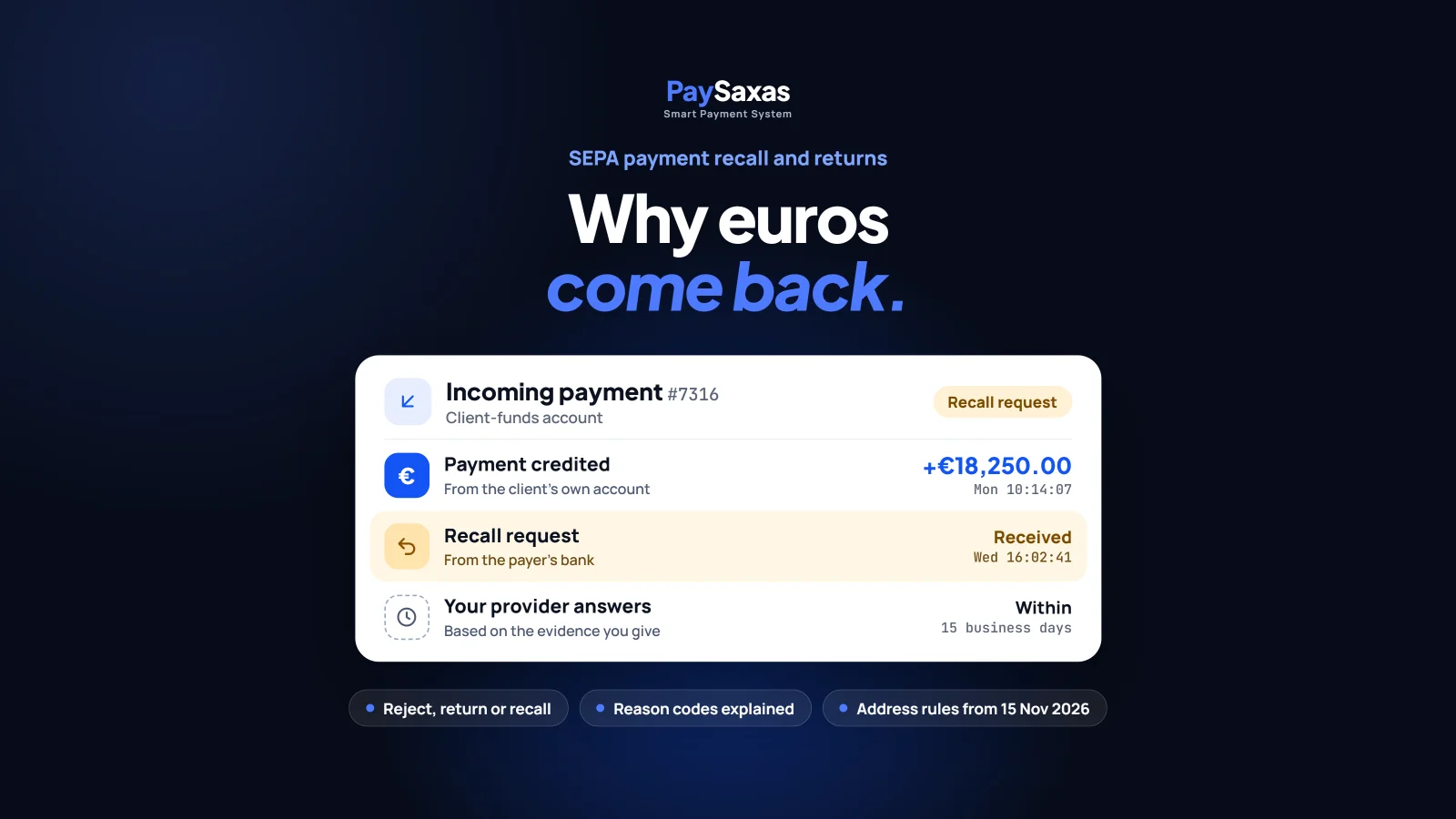
Most SEPA transfers land and stay. Some come back. A payout bounces because the account was closed. Or, a week after a client paid you, their bank sends a SEPA payment recall and asks for the money back.
If your business receives euros from many clients, as an MSB, a crypto OTC desk or an online business, this is part of running the account. It hurts most when you have already delivered: the crypto is sent, the goods are shipped, the payout is made.
This guide explains the three ways euros come back, how a recall works, what the reason codes mean and how to keep returns and recalls rare. It also covers a change on 15 November 2026 that will lead to rejected payments for businesses that are not ready.
Reject, return or recall: three ways euros come back
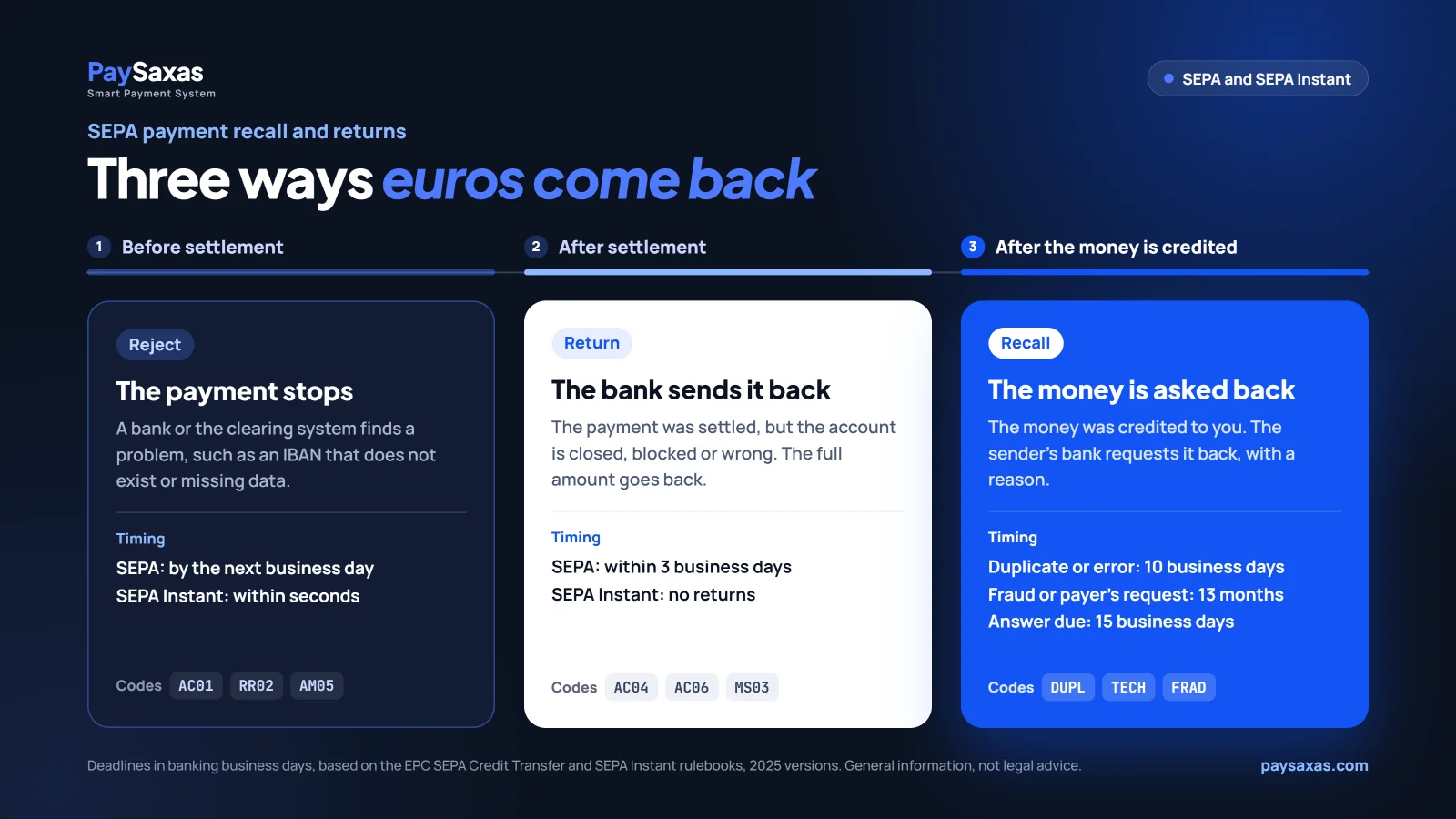
The rules for euro transfers are set by the European Payments Council in the SEPA Credit Transfer rulebook and its SEPA Instant twin. They separate three cases, which differ by timing and by who starts them.
Reject. The payment stops before it is settled. A bank or the clearing system finds a problem, such as an IBAN that does not exist or required data that is missing. For a regular SEPA transfer, the reject reaches the sender's bank by the next business day at the latest. With SEPA Instant, the sender knows within seconds.
Return. The payment was settled, but the receiving bank cannot credit it, for example because the account is closed or blocked. The receiving bank sends the full amount back within three business days after settlement. SEPA Instant has no returns: the receiving bank accepts or rejects the payment within seconds.
Recall. The payment was credited, and the sender's bank asks for it back. This is the case that matters most if you are the one being paid.
When a sender's bank can recall a SEPA payment
A recall is a request, not an automatic reversal. It is allowed only for set reasons and within set deadlines, and the rules are the same for regular SEPA transfers and SEPA Instant.
| Reason | Code | Deadline for the sender's bank |
|---|---|---|
| Duplicate payment | DUPL | 10 business days |
| Technical problem that caused a wrong payment | TECH | 10 business days |
| Fraud | FRAD | 13 months |
| Any other reason the sender gives, such as a wrong IBAN or a wrong amount | AC03, AM09, CUST | 13 months |
The last line is called a request for recall by the originator. It covers everyday mistakes: the client paid too much or typed the wrong IBAN.
Two details are easy to miss. A fraud recall can arrive up to 13 months after the payment, long after the deal was closed. And a request for recall by the originator does not need a specific reason at all.
The receiving bank, which is your provider if the money came to you, has to answer within 15 business days.
How a SEPA payment recall works, step by step
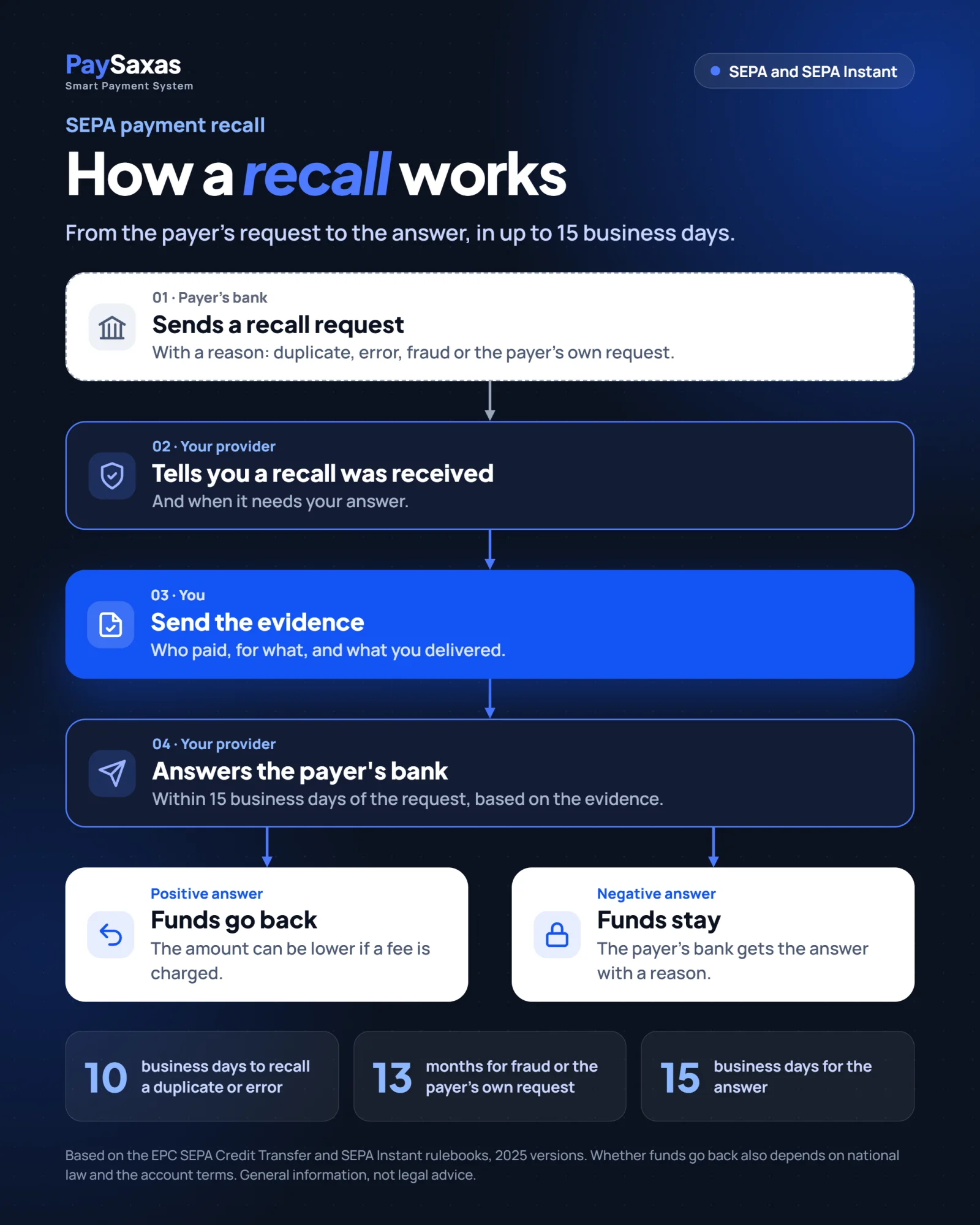
- The sender asks their bank to get the money back, or the bank itself finds a duplicate, an error or fraud.
- The sender's bank sends a recall request with a reason code to your provider.
- Your provider tells you a recall was received and when it needs your answer.
- You send the evidence: who paid, for what and what you delivered.
- Your provider reviews the case and answers the sender's bank, within 15 business days of receiving the request.
What happens to the money
Whether the money goes back depends on national law, your account terms and the facts of the case. Your provider reviews the case, using the evidence you give, and sends one of two answers to the sender's bank.
- Positive answer. The funds go back. The receiving bank may charge a fee for this, so the amount returned can be lower than the original payment.
- Negative answer. For example, the evidence shows the payment was correct and you delivered what was paid for. The sender's bank gets the answer with a reason code.
A negative answer ends the recall under the SEPA rules, but not always the dispute. In a real fraud case, the matter can go further, for example to the police or a court.
SEPA return reason codes and what to do about them
When a payment is rejected or returned, the bank adds a reason code. These are the common ones from the EPC guidance on reason codes:
| Code | What it means | What to do |
|---|---|---|
| AC01 | The IBAN is wrong or the account does not exist | Check the IBAN with the recipient and send again |
| AC04 | The account is closed | Ask the recipient for new account details |
| AC06 | The account is blocked | Ask the recipient to contact their bank first |
| AG01 | The account cannot receive transfers, for example a savings account | Ask for a current or business account |
| AM05 | Duplicate payment | Check whether the first payment arrived |
| BE04, RR03 | The recipient's address is missing or invalid where it is required | Add the address in a structured format |
| RR01, RR02 | Required sender account, name or address details are missing or invalid | Complete your own details in the payment |
| RR04 | Other regulatory reasons, such as an AML or sanctions check | Ask your provider what is needed |
| MS02 | The recipient refused the payment | Contact the recipient |
| MS03 | Reason not specified | Contact your provider and the recipient |
In answers to a recall, FOCR means the money is on its way back. CUST (the recipient refused), LEGL (legal reasons), NOAS (no response), AC04 (account closed), AM04 (insufficient funds) and ARDT (already returned) mean it is not coming back through the recall.
New address rules from 15 November 2026
From 15 November 2026, SEPA payments, including SEPA Instant, that carry an address only as free text will be rejected. Banks will accept a fully structured address, or a hybrid one where at least the town and the country code sit in their own fields. What counts is the execution date of the payment, not the day it was ordered.
Inside the EEA, a payment often needs no address at all. It matters when a bank outside the EEA is involved. If the sender's or the recipient's bank is in a SEPA country outside the EEA, such as the United Kingdom or Switzerland, EU rules require the sender's full address in the payment, as the EPC explains in its clarification paper.
So a UK company paying European partners, or a Swiss client paying your desk, could see payments rejected after the deadline. Store at least the town and country code for every counterparty, update your payment templates and software, and ask your provider how it checks addresses.
How to avoid a SEPA payment recall and returns
Many returns and recalls start with a small gap: a wrong detail, an unclear payer or a slow reply. These habits close the common ones.
- Check the name before every payout. Verification of Payee matches the name against the IBAN before the payment leaves. If a payer goes ahead after a "No match" warning and the money lands in the wrong account, liability generally sits with the payer. Our guide to Verification of Payee explains the results.
- Take payments only from accounts in your client's name. A payment from a relative's or another company's account carries a higher risk of a fraud recall, because the account owner may not know about the deal.
- Put the invoice or trade ID in every payment reference. When a recall request comes in, you find the case in seconds.
- Keep your evidence ready. Client identification, the order or trade confirmation, proof of delivery and your messages with the client.
- Take extra care with new clients and large first payments. For a crypto OTC desk, a fraud recall after delivery can mean losing both the crypto and the euros.
- Refund only to the account the money came from. If you send money back yourself, it is a new transfer to the original account. Never refund to a different account because a caller or an email asks you to. If a recall is open, answer it through your provider instead of refunding separately.
- Reply to recall requests quickly. Your provider has 15 business days to answer the sender's bank and needs your evidence before that.
- Keep counterparty details up to date. Closed accounts and missing addresses are typical return reasons, and the address rules get stricter on 15 November 2026.
How PaySaxas helps with returns and recalls
With PaySaxas Oy, an electronic money institution licensed and supervised in Finland, your business holds euro accounts in its own name. Each account has its own Finnish IBAN and direct access to the SEPA clearing scheme for SEPA and SEPA Instant.
- Your name on the account. Payers see a match when their bank checks your name, so fewer payments stall or go to the wrong place.
- Verification of Payee on outgoing payments, as an additional layer of protection: the counterparty name is matched against the recipient IBAN before your payment leaves.
- A dedicated account manager. If a recall request arrives, we tell you it was received and when we need your evidence. Our team then answers the sender's bank before the deadline.
- Separate accounts for separate flows. Your clients' money on a client-funds account and your own money on an operational account, so every payment is easy to trace. See how this works for a crypto OTC desk.
Final thoughts
Euros that come back are part of running a payment business. A return is usually fixed by correcting the details. A SEPA payment recall needs more: a quick answer, a clear record of the deal and a provider that keeps you informed. Set this up before the first recall arrives.
Talk to our team about euro accounts for your business, or read more about MSB business accounts.
Account opening is subject to KYB and compliance review. PaySaxas Oy does not provide crypto-asset services. PaySaxas is not a bank and does not provide investment advice. E-money is not covered by deposit guarantee; client funds are safeguarded. This article is general information based on the SEPA rulebooks in force in October 2026, not legal advice.
FAQ
What is a SEPA payment recall?
It is a request from the sender's bank to get back a SEPA payment that has already been credited. It is allowed for duplicates, technical errors and fraud, and for other reasons at the sender's own request. The receiving bank has to answer, but the money does not go back automatically.
How long after a payment can a recall request arrive?
Within 10 business days for duplicates and technical errors. Up to 13 months for fraud and for a request for recall by the originator.
Can a SEPA Instant payment be recalled?
Yes. The same recall reasons and deadlines apply. What SEPA Instant does not have is a return: the receiving bank accepts or rejects the payment within seconds.
Does the recipient have to agree to a recall?
It depends on national law and the account terms. Under the SEPA rules, the recipient's provider may return the funds directly or may first need the recipient's authorisation. Either way, the provider reviews the case and sends the answer to the sender's bank.
Can I cancel a SEPA transfer after sending it?
Once the payment has been executed, it cannot simply be cancelled. Your bank can send a recall request for a duplicate or an error, or a request for recall by the originator for other reasons. The money comes back only if the rules allow it, and often only with the recipient's agreement.
What do FOCR and NOAS mean?
They are answers to a recall. FOCR means the recall was accepted and the funds are on their way back. NOAS means the recipient did not respond, so the funds are not returned through the recall.
My client says they paid, but nothing arrived. What now?
Ask the client to request a claim for non-receipt from their bank. For a regular SEPA transfer, the receiving bank has to answer within 10 business days.