

If your company operates in more than one currency, you’ve probably noticed something simple but expensive: every payment that arrives in the “wrong” currency costs you money. A US client pays in USD, but your suppliers are in Europe. A European marketplace settles in EUR, but your contractor invoices in USD. Each automatic conversion is a small loss until you add up a year of them.
Large companies hire treasurers to manage this. Most small and mid-sized international businesses don’t have that option.
The good news: with the right account setup, you don’t need one.
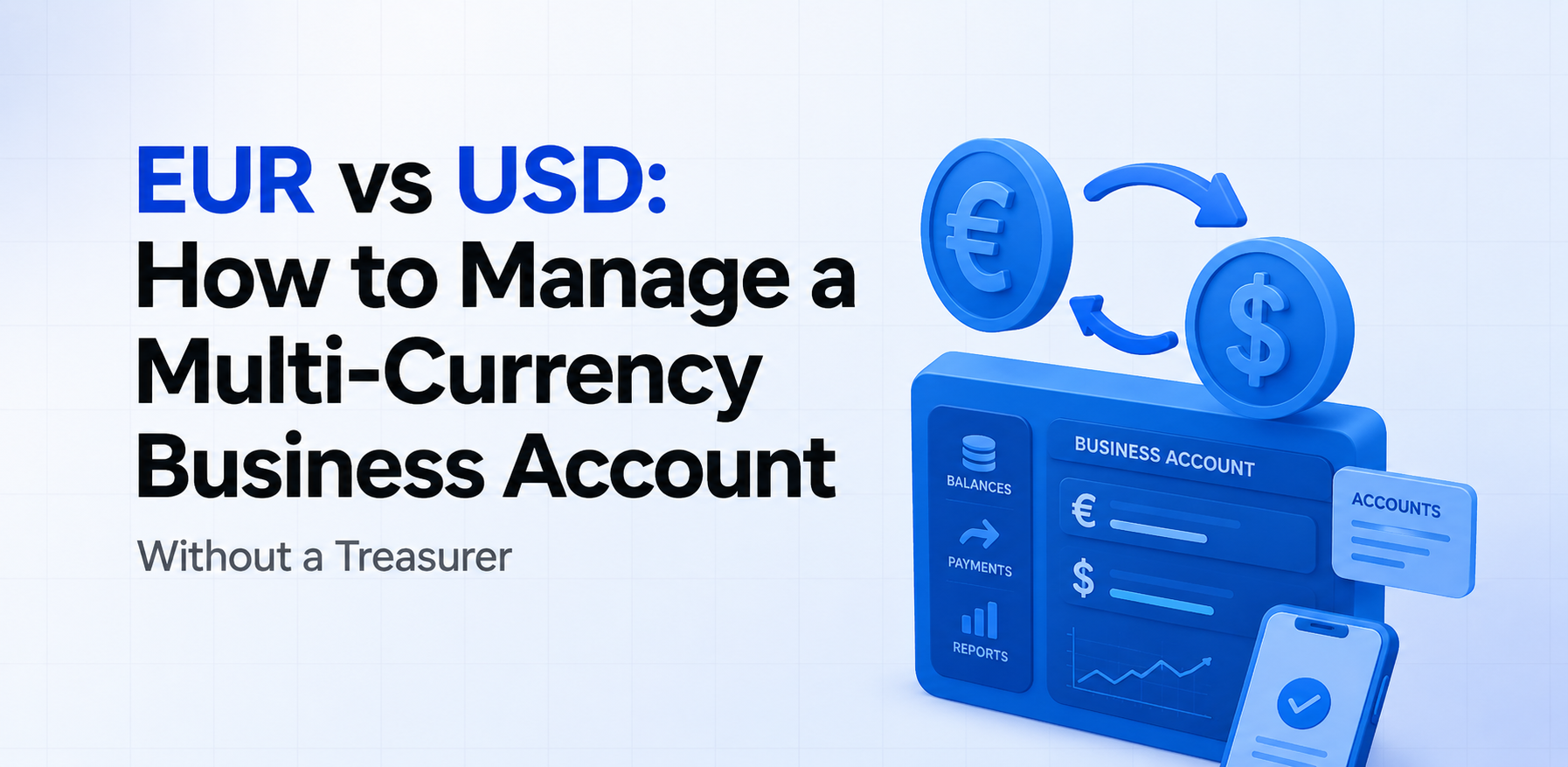
This guide breaks down how to run EUR and USD operations efficiently using a single multi-currency business account.
Why Single-Currency Accounts Cost International Businesses Money
The most common setup for growing international companies is also the most expensive: a single-currency business account with automatic conversion on inbound payments.
Here’s what happens. A client wires you USD. Your account holds EUR. The bank converts on receipt – at a rate that includes a 1–3% margin you’ll never see itemized. Two weeks later, you need to pay a USD invoice. The same bank converts EUR back to USD at another margin. You’ve now paid the spread twice on the same money.
Across a year of operations, businesses lose 2–5% of their cross-currency revenue to compounding FX margins.
For a company processing €500,000 in mixed currencies annually, that’s €10,000–€25,000 leaking out through unnecessary conversions.
The fix isn’t complicated. It’s structural: hold each currency in its own balance and convert only when you actually need to.
What a Functional Multi-Currency Business Account Looks Like
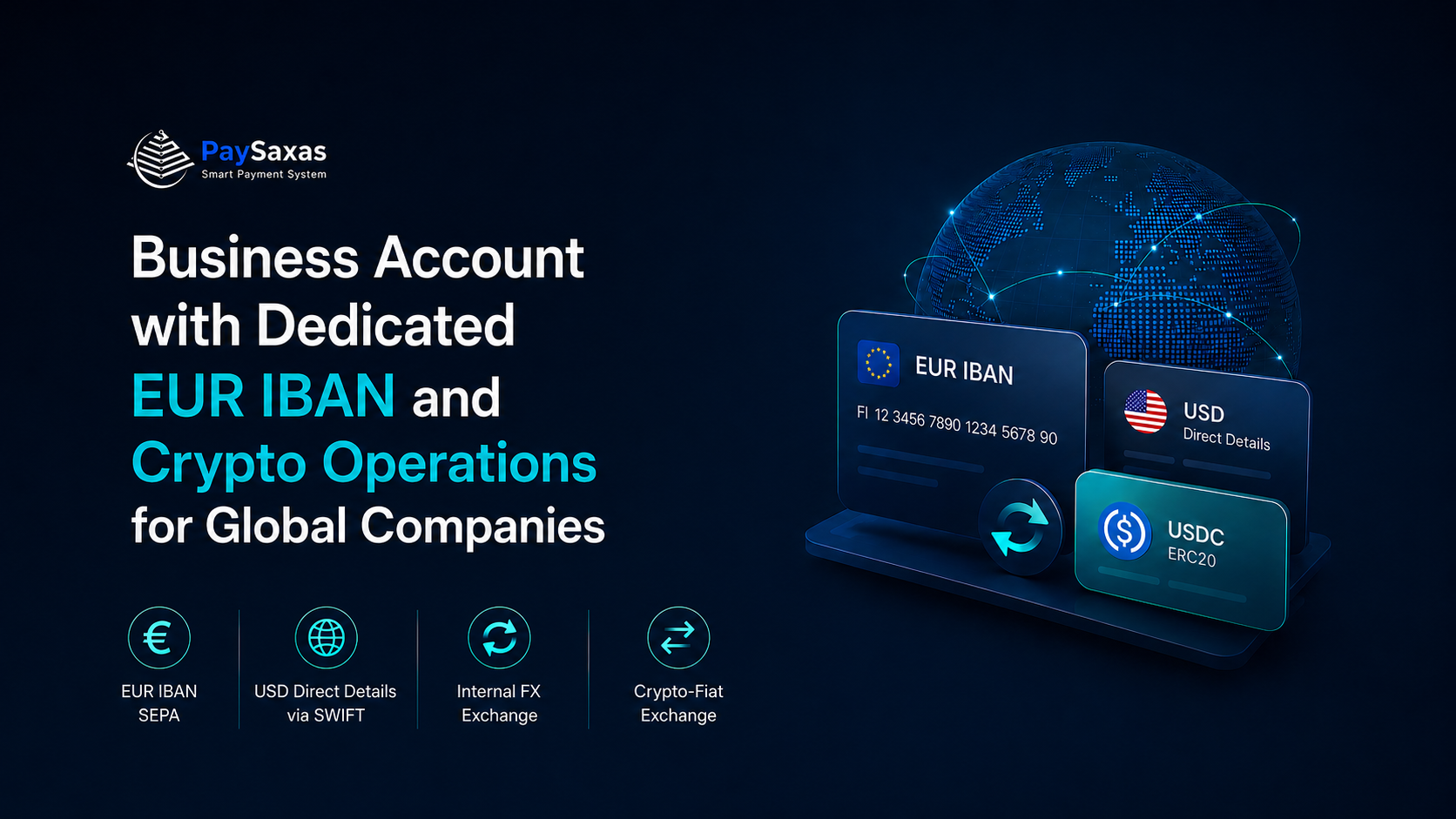
A practical multi-currency setup for an international company has four working parts:
1. A dedicated EUR balance with its own IBAN. Not a virtual or shared IBAN – a real one assigned to your company.
This is what European clients pay into and what your SEPA payments originate from.
2. A dedicated USD balance with direct US payment details. This allows US-based clients, marketplaces, and platforms to pay you in USD without forced conversion to EUR.
3. Internal FX between the two balances. When you actually need to convert paying a EUR supplier from USD revenue, for example, you do it on-platform with a single transparent rate, not through external markets or compounded spreads.
4. A single set of payment rails SEPA, International payments, and ideally crypto that can originate from either balance. You shouldn’t need a different provider for EUR-out, USD-out, and stablecoin transactions.
This is the structure that lets a small finance team or even a single founder manage multi-currency operations without specialized treasury expertise.
The Four Principles of Managing EUR and USD Without a Treasurer
1. Match the Inbound Currency to the Account
Always invoice in the currency your client pays in. If your US clients pay USD, invoice in USD, and receive into your USD balance.
If your European clients pay EUR, invoice in EUR.
This sounds obvious, but many companies invoice everything in EUR (or everything in USD) for accounting simplicity and then absorb conversion costs on every inbound payment. The simpler your accounting, the more expensive your FX bill.
2. Match the Outbound Currency to the Payee
Pay each counterparty in the currency they operate in. EUR supplier → pay from EUR balance via SEPA.
US contractor → pay from USD balance via International payments. Crypto-native partner → pay USDC.
When inbound and outbound currencies are naturally aligned, you minimize the number of conversions you need to perform. Your USD revenue covers your USD obligations. Your EUR revenue covers EUR obligations. Conversion happens only when there’s an actual imbalance.
3. Use Internal FX for Strategic Conversion – Not Automatic Conversion
When you do need to convert (for example, when EUR liabilities exceed EUR income), do it deliberately, not automatically on every transaction.
An internal FX feature inside your business account lets you:
- Convert a chosen amount, at a chosen time, at a transparent rate
- Avoid the per-transaction margin embedded in auto-conversion
- Plan conversions around currency timing rather than incidentally
This is the closest a small business gets to having a treasurer: deliberate, scheduled FX rather than passive, transactional FX.
4. Keep One Compliance Relationship for Both Currencies
Splitting EUR and USD across two providers doubles your KYB process, doubles your reporting overhead, and creates two compliance surfaces instead of one. Consolidating both currencies and ideally crypto operations into a single account simplifies everything from monthly reconciliation to year-end audit.
Need a business account with dedicated EUR IBAN, USD direct details, and internal FX in one place?
See how PaySaxas works for international companies →
Where Crypto Fits in a Multi-Currency Setup
For most B2B companies, crypto isn’t a primary operating currency, but it’s increasingly relevant in specific scenarios:
- Receiving payments from crypto-native clients or platforms
- Paying contractors in markets with limited banking infrastructure
- Moving funds across borders where International payments are slow or expensive
When your business account supports crypto on-ramp and off-ramp natively, meaning you can receive USDC, convert to EUR or USD inside the platform, and pay out via SEPA or International payments without leaving the account crypto becomes a functional third currency rather than a separate operation.
Practical example: a SaaS company receives a USDC payment from a non-US client. Inside the account, USDC converts directly to EUR. From the EUR balance, they pay a European contractor via SEPA. Three steps, one platform, one compliance record.
Without this integration, the same flow requires a crypto wallet, an external exchange, a wire to the business account, and a separate SEPA payment across three or four providers.
Practical Setup for Common Business Types
E-commerce and marketplaces: Receive USD payouts from US platforms into the USD balance. Receive EUR card processor settlements into the EUR balance. Pay European suppliers from EUR via SEPA. Convert internally only when stocking up on inventory denominated in the other currency.
SaaS companies: Bill US subscribers in USD, EU subscribers in EUR. Hold both balances. Cover operational costs (cloud infrastructure, contractors) from the matching currency. Convert only quarterly when distributing to one base currency for reporting.
Agencies and consulting firms: Invoice each client in their local currency. Pay distributed team members in their local currency. Use internal FX once a month to top up balances based on the next month’s projected outflows.
Import/export businesses: Match USD revenue from US clients to USD supplier payments. Match EUR revenue from European clients to EUR supplier payments. Convert strategically based on the larger currency exposure direction.
In all four cases, the underlying logic is the same: keep flows aligned, convert deliberately, consolidate compliance.
A Note on Onboarding
Access to a multi-currency business account through an EMI or fintech depends on KYB and compliance review. Approval isn’t automatic.
Businesses that prepare clear documentation of corporate registration, UBO information, and a coherent description of their cross-currency flows and counterparties move through onboarding faster. PaySaxas works with companies that have legitimate, transparent transaction profiles, focused on the clarity of the business model rather than the industry label.
Final Thoughts
You don’t need a treasurer to manage EUR and USD operations efficiently. You need a business account structured around how international companies actually operate: dedicated balances per currency, transparent internal FX, integrated payment rails, and a single compliance relationship.
The companies that get this right stop losing 2–5% of their cross-currency revenue to invisible conversion margins.
They also stop spending operational time reconciling across multiple providers.
Open a multi-currency business account with PaySaxas →