

If you run an international business, you already know the pain: a payment sent on Monday arrives Thursday, minus fees you didn’t fully anticipate, flagged by a compliance check you weren’t prepared for.
Cross-border B2B payments are slow, expensive, and opaque by design. The traditional correspondent banking system was built decades ago and hasn’t fundamentally changed. Meanwhile, companies are operating across more countries, currencies, and payment types than ever before.
This guide breaks down where the friction comes from and what businesses can actually do to reduce it.
Where the Costs and Delays Actually Come From
Most businesses know that international transfers aren’t free. Fewer understand exactly why.
Correspondent banking chains are the main culprit. When you send an International wire from a European account to a supplier in Southeast Asia, your bank doesn’t transfer funds directly. It routes the payment through one, two, or sometimes three intermediary banks, each taking a cut. By the time the funds arrive, the recipient often receives less than expected, with no clear breakdown of where the difference went.
FX spread is the second hidden cost. Even when a transfer is labeled “fee-free”, the exchange rate applied is rarely the mid-market rate. Banks and some payment providers earn a margin on the spread, the gap between the rate they receive and the rate they pass on to you.
Compliance holds add unpredictable delays. Payments flagged for manual review, because of a new beneficiary, an unusual amount, or a jurisdiction that triggers automated screening, can sit for 1–5 business days without explanation. This is especially common for businesses in fintech, digital services, or markets with elevated AML scrutiny.
Shared account infrastructure compounds the problem. If your business operates through a pooled virtual account (shared IBAN), your transactions are mixed with those of other businesses. Any compliance issue affecting another company in the pool can delay your own payments.
Practical Ways to Reduce Cross-Border Payment Costs
1. Use SEPA for EUR Transfers Within Europe
If you’re paying European suppliers, contractors, or employees in EUR, SEPA should be your default payment method, not SWIFT. SEPA Credit Transfers are low-cost, predictable, and increasingly instant through SEPA Instant (SCT Inst).
SWIFT is designed for cross-currency, cross-region transfers. Using it for an EUR-to-EUR payment between two EU accounts is unnecessary and costly. A business with a dedicated EUR IBAN can originate SEPA payments directly without routing through intermediaries.
2. Separate Your EUR and USD Flows
Many international businesses operate in both EUR and USD, billing European clients in one and US platforms or marketplaces in the other. Holding both in the same account in one currency means constant conversion, and conversion means cost.
A better setup: maintain a dedicated EUR balance for European operations and a USD balance for dollar-denominated activity. Convert only when necessary, using an internal FX tool if available, rather than triggering a conversion on every incoming payment.
3. Reduce Intermediary Hops on International Wires
Not all International transfers are equal. The number of correspondent banks in the chain depends on your bank’s network relationships. Some fintech providers and EMIs maintain direct correspondent relationships with major banks in key corridors: US, EU, UK, UAE, which reduces the number of hops and the associated fees.
When evaluating a business account provider, ask specifically about their International correspondent network for the corridors relevant to your business.
4. Use Stablecoins for Specific Payment Corridors
For some B2B use cases, paying contractors in countries with limited banking access, settling with crypto-native counterparties, or moving funds quickly without a banking intermediary, stablecoin transfers offer a practical alternative.
USDC on ERC20 settles in minutes, at near-zero transaction cost, to any compatible wallet address. For businesses that already have counterparties willing to receive and send USDC, this removes the correspondent banking layer entirely for those specific flows.
The practical value goes further when crypto-to-fiat conversion is available inside the same platform. If you receive a USDC payment from a client and need EUR to pay a European supplier, converting on-platform, rather than withdrawing to an external exchange, converting there, and wiring back, saves two settlement cycles and removes a separate compliance relationship. Platforms that support crypto on-ramp and off-ramp natively turn stablecoin receipts into usable fiat without leaving your business account
This isn’t a replacement for SEPA or SWIFT. It’s an additional rail for situations where traditional banking is slow, expensive, or unavailable.
Compliance: How to Avoid Payment Holds and Rejections
Compliance friction in cross-border payments is often avoidable, not by circumventing rules, but by structuring your operations to be clearly legible to automated systems and human reviewers.
Maintain consistent beneficiary data. Payments to new beneficiaries trigger higher scrutiny. Where possible, set up recurring payees in advance and use consistent reference data on transfers. Inconsistencies between the account name, reference, and purpose of payment increase the chance of a manual review hold.
Document your transaction purpose. For larger International wires, payment purpose codes and invoice references attached to the transfer reduce the likelihood of a compliance hold at the receiving bank. This is standard practice that many businesses skip.
Keep crypto and fiat activity under one KYB. When crypto on-ramp and off-ramp are handled within the same verified business account, all conversion activity is tied to your existing compliance record. This makes it significantly easier to document the source and destination of funds, a common point of scrutiny when crypto and fiat mix across different platforms.
PaySaxas works with businesses that have a legitimate and transparent flow of funds, including categories that traditional banks often decline. The key factor is not the industry label, but the clarity of your business model and compliance documentation.
Looking for a business account that covers SEPA, SWIFT, and crypto in one place?
See how PaySaxas works for international companies →
What a Modern Cross-Border Payment Setup Looks Like
For most international B2B companies, the optimal setup involves:
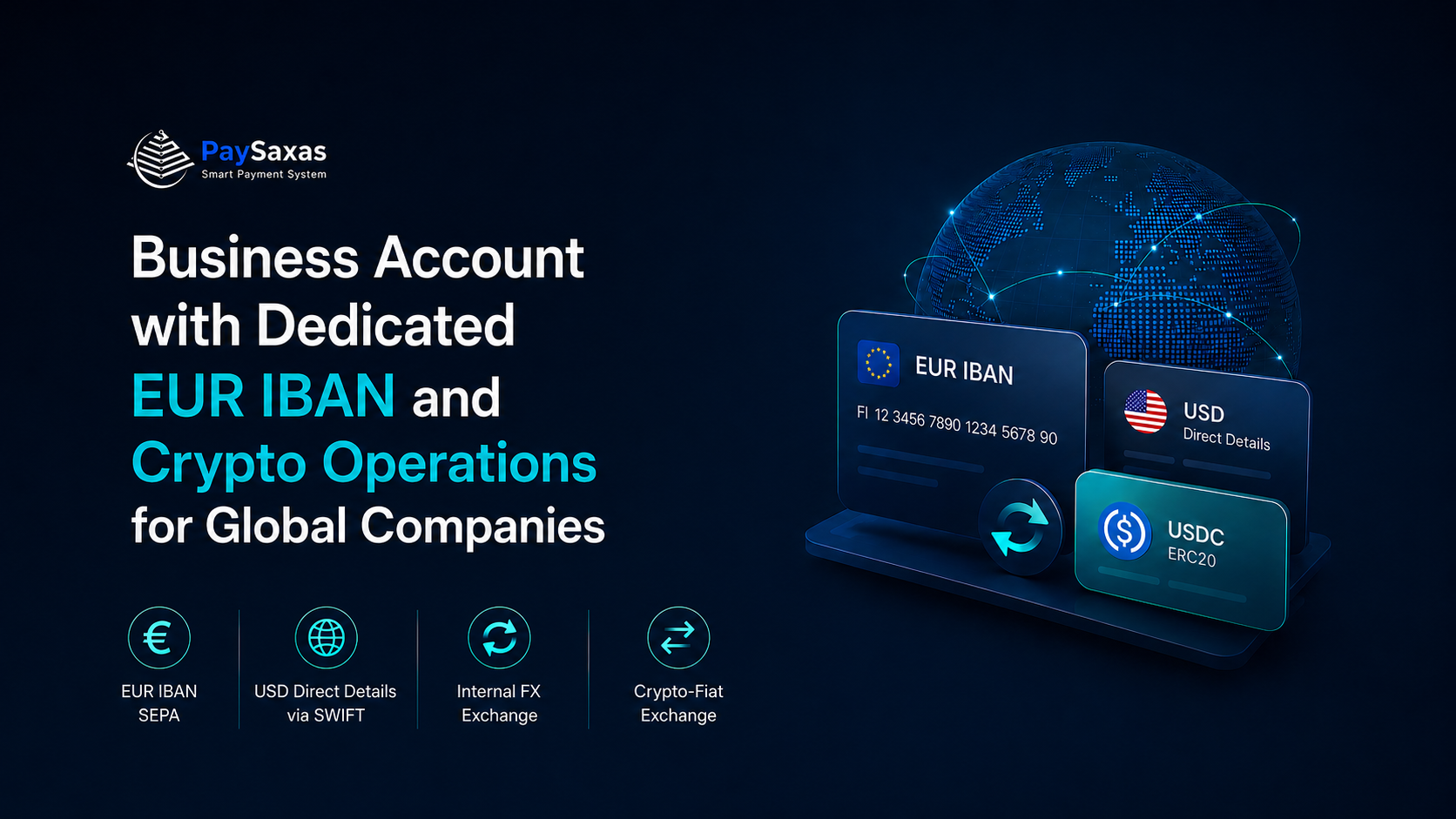
A dedicated business account under the company name, not a pooled or virtual account. This means a real IBAN assigned to your entity for EUR operations and direct USD details for dollar flows.
SEPA access for cost-efficient EUR transfers across Europe, with International wires for non-EU corridors and cross-currency wires.
Internal FX for converting between EUR and USD balances without leaving the platform or triggering external currency exchange spreads.
Crypto on-ramp and off-ramp, the ability to receive USDC, convert to EUR or USD within the account, and move fiat out via SEPA or SWIFT in a single workflow. And equally, the reverse: fund a USDC transfer from a fiat balance when a counterparty prefers stablecoin settlement. This makes crypto a functional payment rail for B2B operations, not a separate activity requiring a separate platform.
Single compliance relationship, one provider, one KYB, one set of account terms. This simplifies reporting, reconciliation, and the management of compliance documentation.
This isn’t a theoretical setup. Platforms like PaySaxas combine these capabilities in a single business account designed for international companies operating across fiat and crypto rails.