

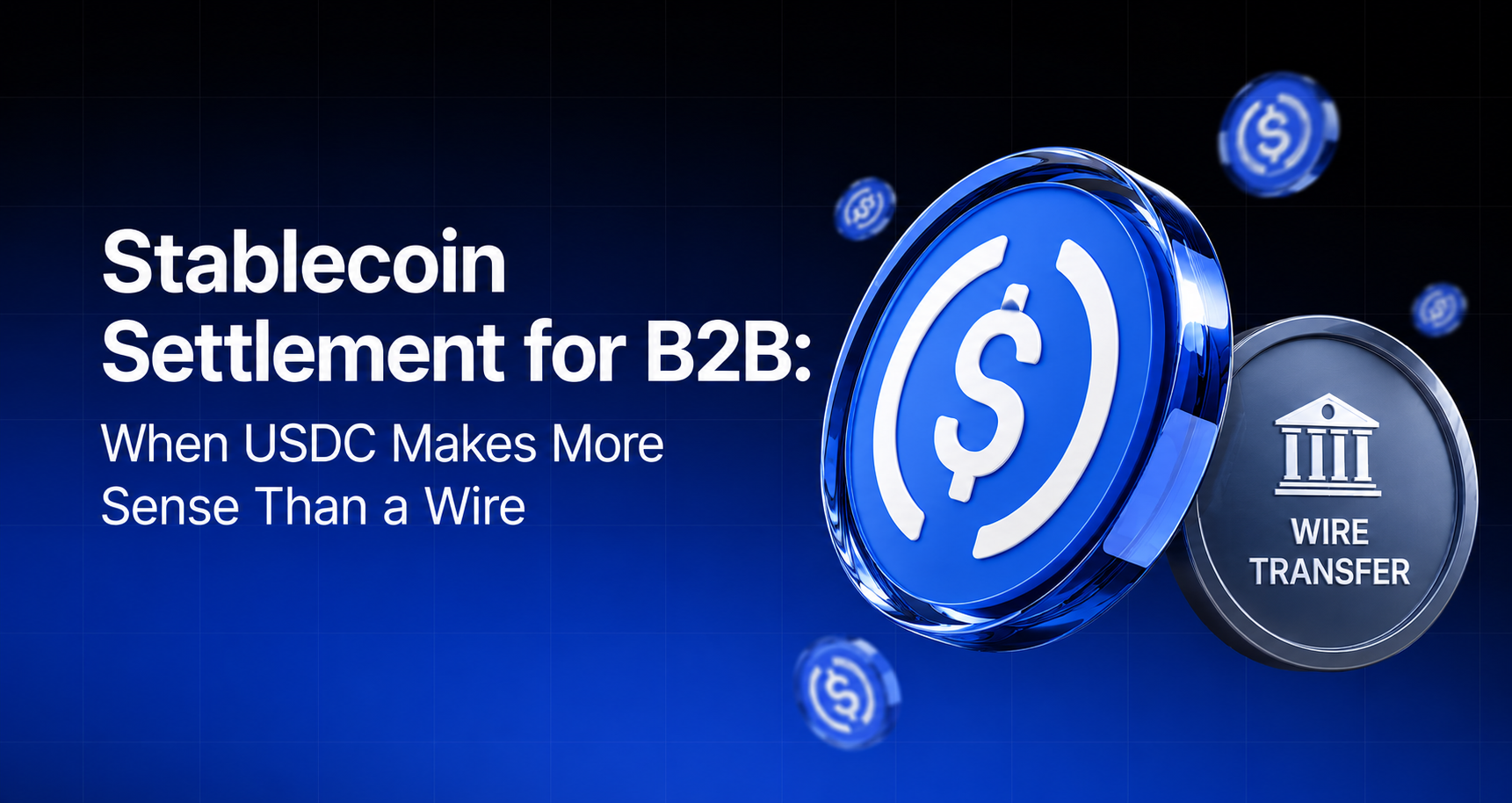
A standard international wire takes one to four business days, passes through several intermediary banks, and arrives minus fees that nobody itemized. A USDC transfer settles in minutes, costs a few dollars in network fees, and arrives in full.
So why isn’t every B2B payment running on stablecoins?
Because receiving USDC is the easy part.
The real question for any business is what happens next: how do you turn that USDC into EUR to pay a European supplier, or into USD to cover a dollar invoice? This guide breaks down when USDC genuinely outperforms a wire, and how the conversion side works when it’s built into your business account.
What USDC Settlement Actually Means for a Business
USDC is a stablecoin pegged 1:1 to the US dollar, issued by Circle, with reserves held in cash and short-term US Treasuries. For business purposes, one USDC functions as one digital dollar that moves on blockchain rails instead of banking rails.
When a counterparty sends you 50,000 USDC on the ERC20 network, the transfer is final within minutes, visible on-chain, and independent of banking hours, correspondent chains, or cut-off times. There is no intermediary bank deducting fees in transit. What’s sent is what arrives.
The catch is simple: USDC is only useful if you can convert it into the currency your business actually runs on. A balance you can’t pay suppliers or salaries with isn’t liquidity. This is why the real value isn’t in accepting USDC. It’s in converting USDC to EUR or USD quickly, at a clear rate, without leaving your business account.
USDC to EUR and USDC to USD: The Conversion Is the Product
For most companies exploring stablecoin settlement, the workflow they actually need looks like this:
Receive USDC, operate in EUR. A client or platform pays you in USDC. Your suppliers, contractors, and office costs are in EUR. You need a direct path: USDC arrives, converts to EUR on-platform, and goes out via SEPA from your dedicated EUR IBAN. No external exchange, no waiting for a withdrawal wire.
Receive USDC, operate in USD. Your counterparty settles in USDC, but your obligations are dollar-denominated. Same logic: convert USDC to USD inside the account and pay out through International payments using your direct USD details.
Hold all three, convert when needed. Some businesses keep USDC, EUR, and USD balances side by side and convert deliberately, based on upcoming payments, rather than automatically on every receipt. Combined with internal FX between EUR and USD, this gives a small finance team full routing control: USDC to EUR, USDC to USD, EUR to USD, and back.
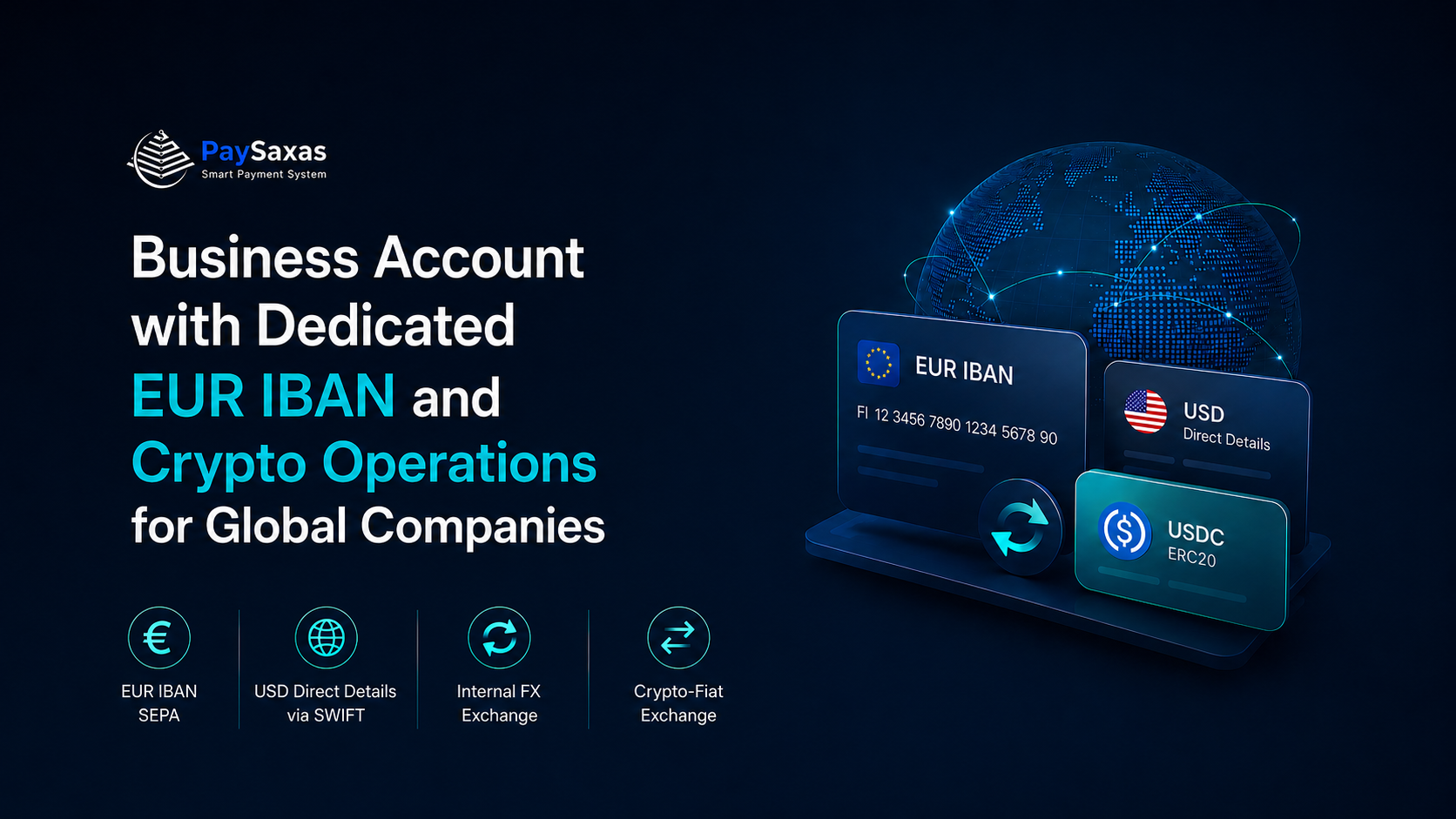
This is exactly how PaySaxas structures it. USDC (ERC20) in and out, conversion to EUR or USD inside the platform, and fiat payouts via SEPA or International payments from the same account. One platform, one KYB, one transaction history.
The reverse direction works too. If a counterparty prefers stablecoin settlement, you can fund a USDC transfer from your EUR or USD balance. Crypto stops being a separate operation and becomes a third currency in your treasury.
When USDC Outperforms a Wire
1. Paying Contractors in Markets With Limited Banking Access
International payments to contractors in parts of Latin America, Africa, Southeast Asia, and Eastern Europe are slow and expensive by default. Transfers can take a week, fees can be high, and rejections are common.
A contractor with a crypto wallet receives USDC in minutes at near-zero cost. For distributed teams, this often becomes the default payout method simply because it’s the most reliable one available.
2. Settling With Crypto-Native Counterparties
If your clients or partners operate in Web3, digital assets, or crypto-adjacent services, they often prefer stablecoin settlement and sometimes offer nothing else. Refusing USDC in these relationships means losing the deal.
Accepting USDC directly, then converting to EUR or USD when you need fiat, keeps the commercial relationship simple on both sides. You take payment in their currency and run your business in yours.
3. Moving Funds Urgently Outside Banking Hours
Wires don’t move on weekends, holidays, or after cut-off times. Blockchain networks don’t have business hours. When a payment genuinely cannot wait until Monday, USDC is sometimes the only rail that settles today.
4. High-Fee Corridors
For some country pairs, the all-in cost of an international wire reaches 4 to 7% of the payment: sending fee, intermediary deductions, FX margin, receiving fee. In these corridors, even after accounting for conversion at both ends, USDC settlement is materially cheaper.
5. Payments Where Transparency Matters
Every USDC transaction is recorded on-chain with a timestamp and transaction hash. For businesses that need verifiable proof of payment, such as milestone payments or dispute-prone relationships, this transparency is a feature wires can’t match.
When a Wire Is Still the Better Choice
Stablecoins are a rail, not a religion. There are clear situations where traditional payments win:
The counterparty needs fiat and has no crypto setup. If your supplier invoices in EUR and banks normally, a SEPA transfer from a dedicated EUR IBAN is cheap and fast. Introducing USDC here adds steps, not value.
Regulatory or contractual requirements specify bank transfer. Some industries, jurisdictions, and contracts require settlement through regulated banking channels. Don’t engineer around this.
Large payments where the counterparty’s off-ramp is uncertain. Sending six figures in USDC to a partner who then struggles to convert it cleanly creates risk for both sides. If you don’t know how they’ll convert to fiat, ask before sending.
The practical takeaway: USDC complements SEPA and International payments. The businesses that benefit most run all three rails from one account and choose per payment.
Why the Usual Crypto-to-Fiat Setup Fails
Here’s where most B2B stablecoin setups break down.
A company that accepts USDC without integrated infrastructure ends up with this flow: receive USDC to a standalone wallet, transfer it to a crypto exchange, complete the exchange’s KYC, sell USDC for fiat, withdraw via wire to the business account, then wait for settlement. Five steps, three platforms, two settlement delays, and a compliance trail scattered across providers.
This overhead is why many CFOs conclude stablecoins “aren’t worth it.” The problem isn’t the asset. It’s the fragmentation.
With conversion built into the business account, the same flow takes three steps: USDC arrives in the account, converts to EUR or USD at a rate shown before execution, and pays out via SEPA or International payments. The exchange you would have used externally is now a function inside the account you already have.
Need to receive USDC and convert it to EUR or USD in one account?
See how PaySaxas works for international companies →
Compliance: Doing USDC Settlement Properly
Stablecoin settlement doesn’t exempt a business from compliance. It changes what good compliance looks like.
Keep crypto activity under your business KYB. When USDC flows through the same verified business account as your fiat operations, every conversion to EUR or USD is tied to your existing compliance record. Source and destination of funds, the first question in any review, is answerable from one transaction history.
Document the commercial purpose. Treat USDC invoices like any other invoice: counterparty name, amount, service description, payment reference. An on-chain transaction hash attached to a proper invoice is strong documentation. A bare wallet transfer with no paper trail is a red flag.
Know your counterparty. The same diligence you’d apply before wiring funds applies before sending USDC. Settlement finality cuts both ways: there are no recalls on blockchain transfers.
Account for it correctly. USDC received and converted to fiat is revenue like any other. Align with your accountant on treatment before volumes grow, not after.
Businesses with a transparent flow of funds and clear documentation handle this without difficulty. The clarity of your business model matters more than the fact that crypto is involved.
Final Thoughts
USDC is not a replacement for bank wires. It’s a payment rail with a specific profile: instant settlement, low cost regardless of corridor, no banking hours, full transparency. And one dependency that decides everything: how efficiently you can convert it to EUR or USD when you need fiat.
For businesses paying distributed teams, settling with crypto-native partners, or operating in expensive payment corridors, USDC solves real problems wires can’t. The companies capturing the benefit aren’t the ones that went all in on crypto. They’re the ones that added USDC as one more rail inside a properly structured business account, with conversion to EUR and USD on tap, and route each payment to whichever rail does the job best.
Open a multi-currency business account with PaySaxas →
Account access is subject to KYB and compliance review.