Crypto exchange banking: non-custodial flows, safeguarding and BaaS under one roof
By Artem Balduk, Account Executive at PaySaxas
Crypto exchange banking used to come down to one question: will anyone open an account for us? Today the questions are more specific. Where do retail clients' euros land in a non-custodial flow? Where do client balances sit once safeguarding comes into play? And how do you give your own clients IBANs in their names without becoming a bank yourself?
This guide is for MSBs, VASPs, CASPs and PSPs that run crypto exchanges, non-custodial exchanges and crypto OTC desks. It follows the three stages we see most often, the pains at each stage and what PaySaxas covers, from the first pooled account to BaaS.
MSB, VASP, CASP, PSP: who is who
The same business can carry several labels, depending on the country and the regulator. This is how the terms are used in this guide.
| Term | Where it is used | What it means |
|---|---|---|
| MSB | Canada | Money services business registered with FINTRAC. Dealing in virtual currency is one of the MSB activities. |
| VASP | FATF and many national regimes | Virtual asset service provider: a business that exchanges, transfers or keeps crypto for others. |
| CASP | EU | Crypto-asset service provider authorised under MiCA. The transitional periods ended on 1 July 2026 at the latest. |
| PSP | Canada, EU and other markets | Payment service provider. In Canada, PSPs register with the Bank of Canada under the Retail Payment Activities Act (RPAA). |
| MSB-PSP | Canada | An MSB that is also registered as a PSP, so the RPAA applies too, including safeguarding when it holds end-user funds. |
For us, all of them are regulated clients: businesses that hold the licence or registration their activity requires. Every regulated client is assessed case by case.
Three stages of crypto exchange banking
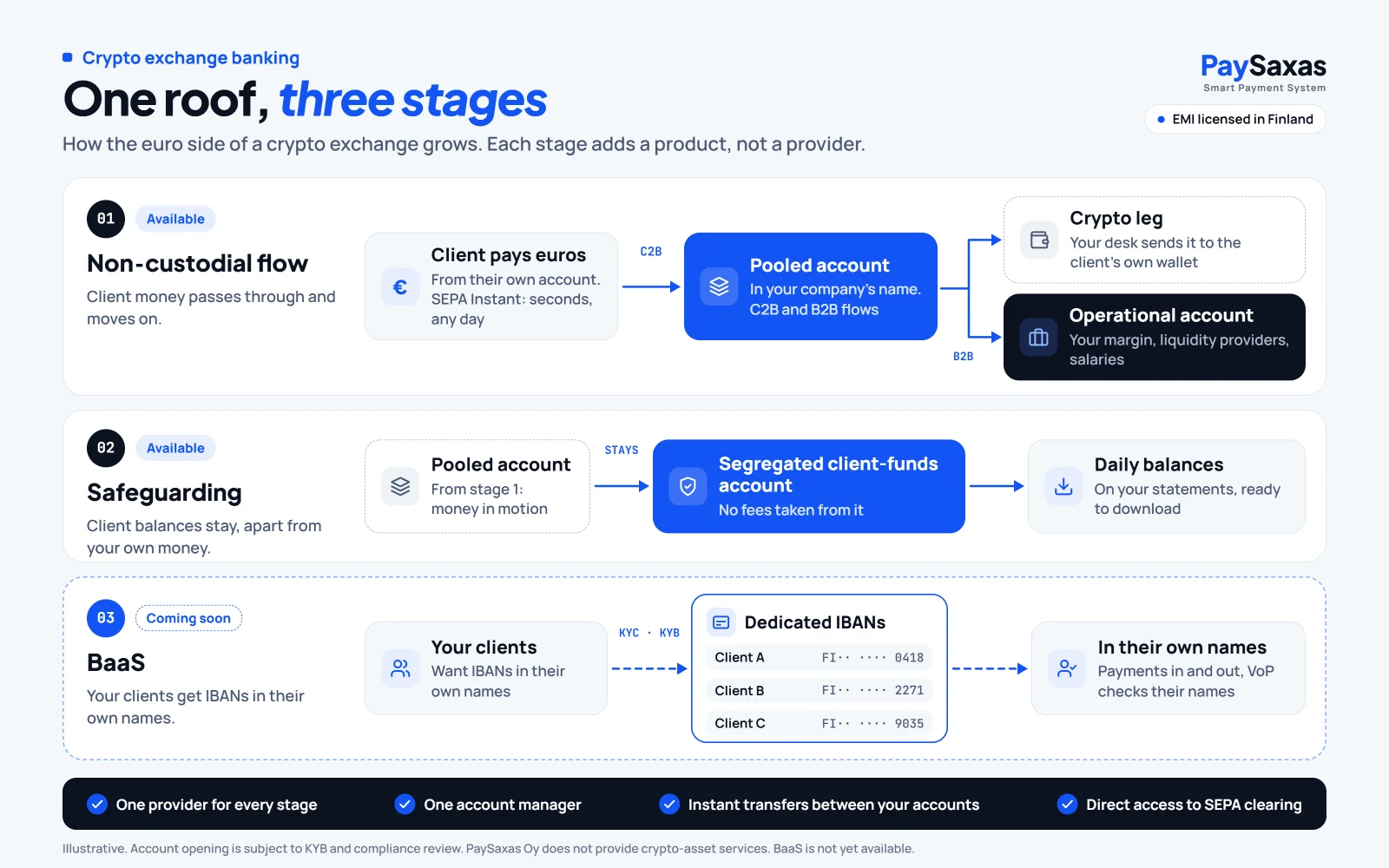
Most crypto businesses we talk to are at one of three stages. The euro side looks different at each one.
- Non-custodial flow. You collect euros from clients and send crypto to their own wallets. Client money passes through and moves on.
- Safeguarding. Client balances start to stay with you, or your regulator expects them to be safeguarded.
- BaaS. Your clients want IBANs in their own names.
Stage 1: banking for a non-custodial crypto exchange
Many crypto businesses we talk to have moved to a non-custodial model, often together with a move from a VASP registration to an MSB registration. In a non-custodial flow, the client pays euros, you send the crypto straight to the client's own wallet, and no client crypto stays on your platform. When a client sells, it works in reverse: the client sends crypto, and you pay euros to the client's own account.
The crypto side gets simpler. The euro side does not go away. Every order still starts or ends with a payment to or from a retail client (C2B), and every day ends with settlements to liquidity providers and partners (B2B flow).
Where it hurts
- Accounts that take B2B payments but not C2B. Many providers will bank a crypto business for its own payments but refuse payments from its retail clients.
- Orders that wait for the money. A standard SEPA transfer settles on business days, so a Saturday order can wait until Monday.
- Payments from the wrong people. A payment from a relative's or a company's account looks fine until a recall arrives. See why euros come back.
- Name warnings on your clients' side. When the name a client types does not match your account, Verification of Payee shows a warning and the client may stop the payment. See why clients see "No match".
- Client money and company money in one account. Reconciliation takes longer, and auditors ask more questions.
What PaySaxas gives you
- A pooled account in your company's name for client money in motion: C2B collections, payouts and B2B settlements. It has its own Finnish IBAN.
- Incoming SEPA Instant. When the client's bank sends the payment by SEPA Instant, the euros arrive in seconds, any day of the year.
- The payer's name on every incoming payment, so you can check that the money came from the client you verified.
- Payouts to your clients' own accounts by standard SEPA transfer on business days, with Verification of Payee before each payment leaves.
- An operational account for your own money: margin, liquidity providers, salaries and taxes. PaySaxas fees are charged to this account, never to the accounts that carry client funds.
- Instant internal transfers between your own accounts at PaySaxas.
The crypto leg stays with you: PaySaxas Oy does not hold, exchange or transfer crypto-assets. For a closer look at how a trade settles, read our guide to crypto OTC desk banking.
Stage 2: safeguarding for pooled accounts
A pooled account is built for money in motion. Things change when client balances start to stay: you keep euro balances for clients between trades, or you register as a PSP.
In Canada, the RPAA safeguarding rules have applied since 8 September 2025. A PSP that holds end-user funds must safeguard them, in a trust account or in an account covered by insurance or a guarantee, and keep them apart from all other funds. Even where no law requires it, auditors and banking partners often ask to see segregated client money.
Where it hurts
- Client balances mixed with operating cash. With one account, it is hard to show what belongs to whom.
- No written proof. Your regulator or auditor wants to see how client money is held, in writing.
- Fees taken from client money. Charges debited from the account with client funds leave you short of what you owe your clients.
- One more provider. A separate safeguarding provider means another onboarding, another portal and slower transfers between your accounts.
What PaySaxas gives you
- A segregated client-funds account, designated as holding your clients' funds and kept separate from your operational account.
- The designation on your statements, so it is clear whose money the account holds.
- No fees taken from it. PaySaxas fees are charged to your operational account, so client balances stay whole.
- Daily balances to download, for your reconciliation and reporting.
- The same provider and the same account manager. Money moves between your pooled and client-funds accounts by instant internal transfer.
The set-up does not replace your own safeguarding assessment. Whether it meets your regulator's rules is for you and your counsel to confirm. The details for Canada are in our guide to RPAA safeguarding for MSBs.
Stage 3: BaaS for your clients' own IBANs (coming soon)
Some MSBs and PSPs go one step further. Their clients, often businesses, want an IBAN in their own name instead of a reference on your pooled account. This is where Banking-as-a-Service (BaaS) comes in.
Where it hurts
- Matching by reference. Every payment into a pooled account has to be matched to a client by its reference. A missing or wrong reference means manual work.
- Clients who want their own name on the account: for their counterparties, for Verification of Payee and for their bookkeeping.
- Another vendor. A separate BaaS provider adds a second relationship next to the one that holds your own accounts.
What PaySaxas BaaS will give you
- Dedicated IBANs for your clients: a real Finnish IBAN in each client's own name, no virtual IBANs.
- Each client opens its own PaySaxas account. Your client goes through KYC or KYB with us and accepts our terms itself. You see the status of the application where your client agrees to share it.
- Accounts you manage through the BaaS API, under each client's mandate.
- Payments in your clients' names, so Verification of Payee checks their names, not yours.
- No new provider. BaaS sits next to your operational, pooled and client-funds accounts at PaySaxas.
BaaS is launching soon. You can open your operational and pooled accounts now and add BaaS when it goes live, with the same team.
Crypto exchange banking under one roof
Each stage adds a product, not a provider. That is what one roof means for your business.
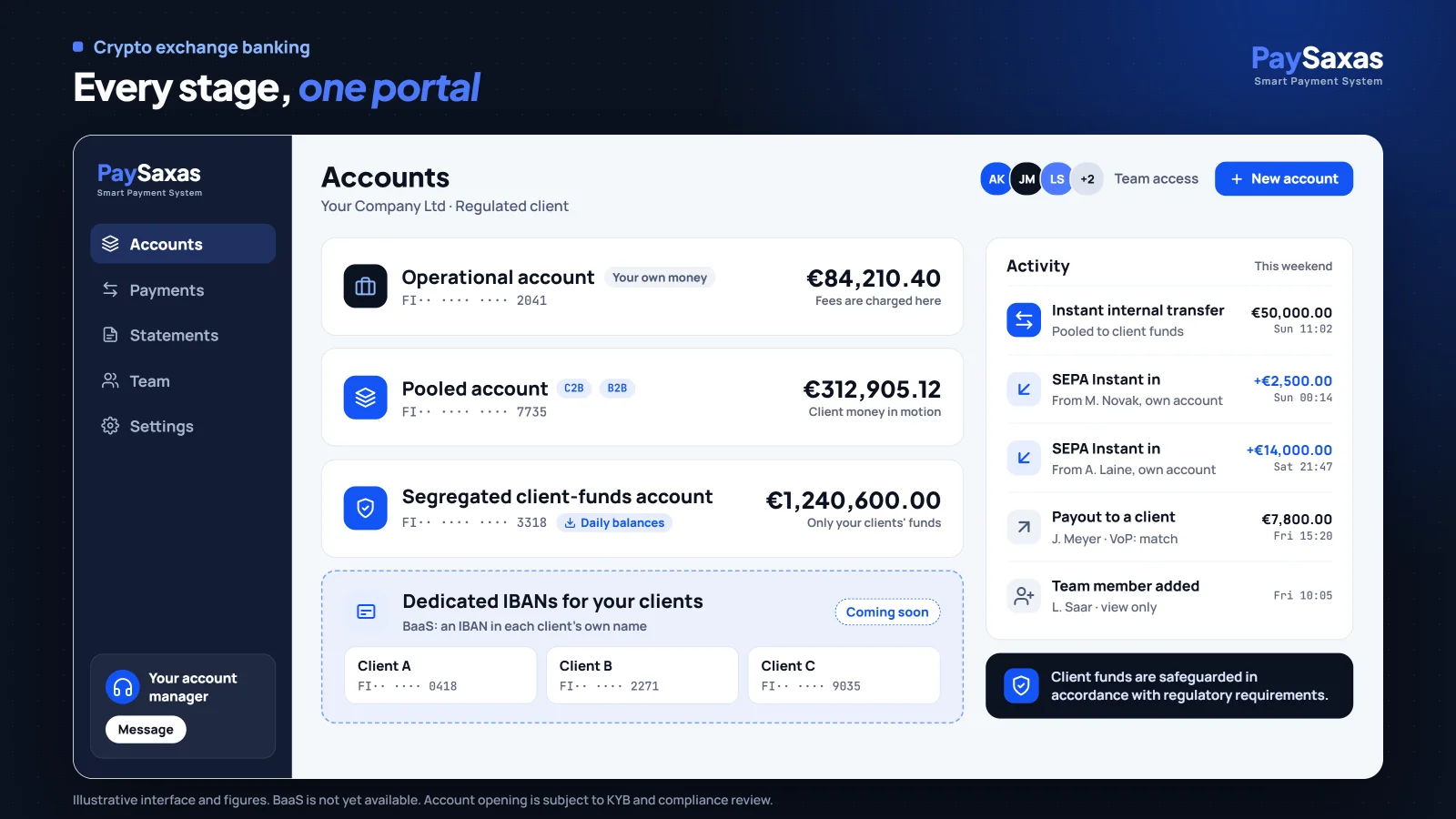
- One provider for every stage: operational, pooled and segregated client-funds accounts today, BaaS soon.
- A dedicated account manager from onboarding, who stays your point of contact, knows your business and helps with day-to-day questions.
- Real Finnish IBANs in your company's name, one per account.
- Direct access to the SEPA clearing scheme: incoming SEPA Instant, and Verification of Payee on outgoing payments as an additional layer of protection.
- Team access. Add colleagues to the account, each with their own access.
- Licensed in Finland. PaySaxas Oy is an electronic money institution supervised by FIN-FSA. Client funds are safeguarded in accordance with regulatory requirements.
Choosing your crypto exchange banking set-up
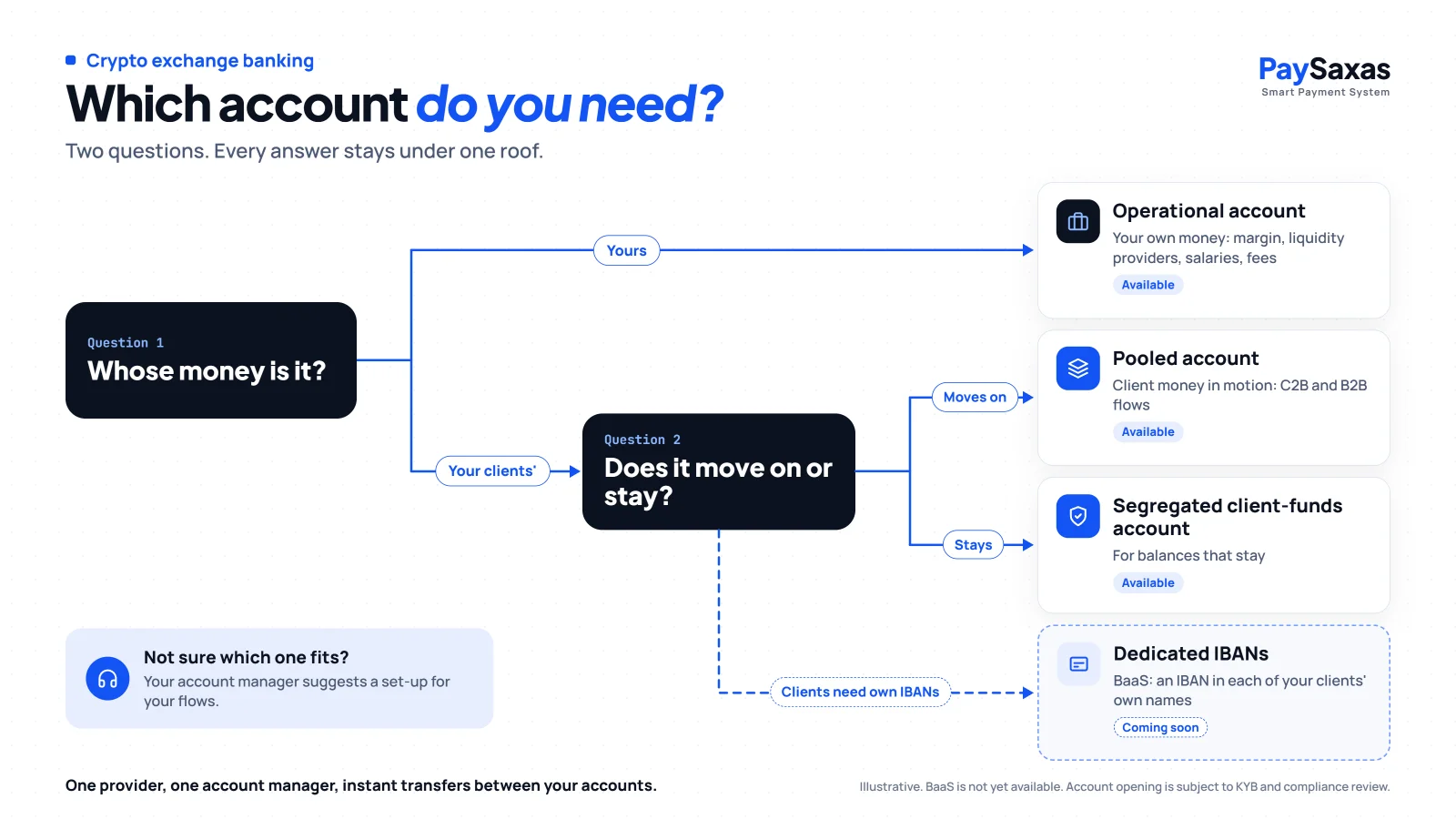
| Your situation | What you need | Status |
|---|---|---|
| You run a non-custodial exchange or a crypto OTC desk and collect euros from clients | Pooled account and operational account | Available |
| You hold client balances or must safeguard end-user funds, for example as an MSB-PSP | Segregated client-funds account, next to the pooled and operational accounts | Available |
| Your clients want IBANs in their own names | BaaS: dedicated IBANs for your clients | Coming soon |
What we look at during onboarding
Crypto exchange banking usually starts with enhanced due diligence. Expect questions about:
- your licence or registration, such as FINTRAC MSB, Bank of Canada PSP or MiCA CASP, and the markets you serve;
- ownership and management (KYB) and your AML programme;
- how you verify your clients (KYC) and screen wallets and counterparties;
- expected C2B and B2B volumes, ticket sizes and countries;
- for safeguarding, your safeguarding framework; for BaaS, who your clients are and how you plan to bring them on board.
A word on clients in the EU: PaySaxas Oy provides euro accounts, not a crypto licence. If you serve clients in the EU, check with your counsel whether MiCA applies to you. The transitional periods ended on 1 July 2026 at the latest; see our MiCA deadline guide.
Final thoughts
Crypto exchange banking should grow with your business. Start with a pooled account and an operational account for your non-custodial flow. Add a segregated client-funds account when client balances stay. Move to BaaS when your clients need IBANs of their own. You keep the same provider and the same account manager at every step.
Tell us which stage you are at, and we will suggest a set-up for your business.
Account opening is subject to KYB and compliance review. PaySaxas Oy does not provide crypto-asset services. BaaS is not yet available. PaySaxas is not a bank and does not provide investment advice. E-money is not covered by deposit guarantee; client funds are safeguarded. This article is general information, not legal advice.
FAQ
What is crypto exchange banking?
Accounts that cover the fiat side of a crypto business: collecting payments from clients, paying out, settling with liquidity providers and keeping client money apart from your own.
Can a Canadian MSB get crypto exchange banking in Europe?
Yes. PaySaxas Oy opens EUR accounts with Finnish IBANs for regulated clients, including Canadian MSBs that run non-custodial exchanges and crypto OTC desks. Every regulated client is assessed case by case.
What is the difference between a pooled account and a segregated client-funds account?
A pooled account is for client money in motion: payments come in and move on. A segregated client-funds account is for client balances that stay. It is designated as holding only your clients' funds, the designation shows on your statements, no fees are taken from it, and you can download daily balances.
Does a PaySaxas segregated client-funds account meet the RPAA rules?
It keeps your clients' funds apart from your own money, designated as such on your statements. It does not replace your own RPAA assessment. Whether an account at PaySaxas Oy is an eligible account under the Bank of Canada guideline is for you and your counsel to confirm.
When will PaySaxas BaaS be available?
Soon. You can open your operational and pooled accounts now and add dedicated IBANs for your clients when BaaS goes live. Contact us if you want to be among the first partners.
Does PaySaxas exchange crypto?
No. PaySaxas Oy provides euro accounts and SEPA payments. The crypto leg stays with you.
Can clients pay on weekends?
Yes, if their bank sends the payment by SEPA Instant: incoming SEPA Instant payments arrive in seconds, any day of the year. Payouts go by standard SEPA transfer on business days.